
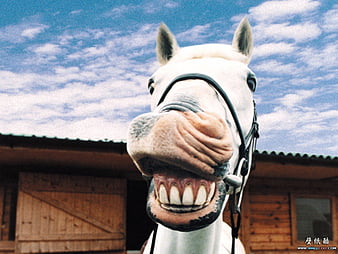
During any given work week at Advanced Equine Dentistry, we get the somewhat stressful task of telling a client that the new horse they were “assured” is “10 years old” is actually much, much closer to 20. Sometimes it is as simple as the previous owner never knew the horse’s real age and of course, sometimes they have been misled. Sadly, aside from a cursory glance, most pre-purchase examinations don’t focus on dentition unless abnormalities are obvious and they also frequently don’t see enough of the teeth to gather information about aging. If the horse changes hands without a veterinary exam, the new owner often bases the horse’s age on the EIA coggins they are given…..which in no instance is proof of age for any horse. Unless the horse is registered, with a recorded date of birth, the teeth are the most accessible method to determine their age.
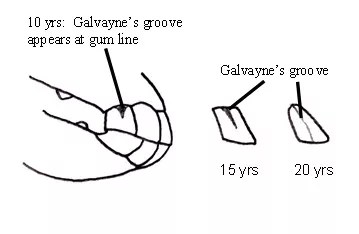
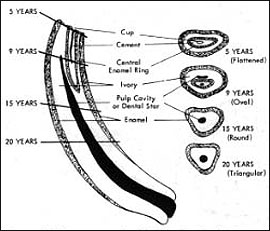
The reason that aging horses by their dentition is accurate to about +/- six months is based on the specific growth and eruption patterns of equine teeth. Horses teeth change shape uniformly as they erupt over the years and the markings visible to your equine dentist are specific to specific developmental stages. To actually accurately age a horse, it is imperative that the horse’s teeth be examined for their shape and growth angle, the position of the “cups” and dental star, the presence and length of the Galvayne’s groove, development of 7 and 11 year hooks, and the wear of the first premolars. Those assessments evaluated all together allow for the closest estimate of age. Aging a horse is definitely more involved than flipping up their top lip and looking at the incisors. While most clients know that the “Galvayne’s grove” is significant in determining age, what they don’t often know is that it simply isn’t enough information for accuracy AND that it can be altered by a “less than honest” horse dealer with a file or dremmel.
A great horse is still a great horse….even if they turn out to be 10 years older than you planned, but it certainly can change both your expectations of the horse and your future care of them if you find out after you get home. To help avoid the surprise, take the time to learn about your horse’s teeth….and of course, call your equine dentist or veterinarian for help!
 Advanced Equine Dentistry Inc.