
The short answer to that question…..absolutely YES! In fact, horses should have their front teeth (incisors) examined and aligned at each and every dental visit.

If we consider equine dental anatomy, the reason is pretty clear. Horse’s front teeth touch; they should line up evenly and make contact across all incisors. This point of contact influences how a horse’s teeth make contact with their molars (chewing teeth) and abnormalities in the incisors can alter their ability to move their jaw and chew. The opposite is true too…abnormal tooth surfaces on the molars alter the contact of the incisors….but for some reason, horse owners seem less aware (and less demanding) of the appropriate care needed for those front teeth!
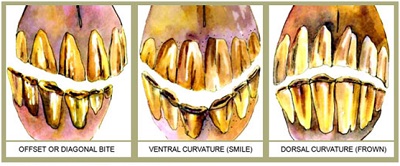
Some of the most common abnormalities we see are offsets and specific curvatures of the incisors, like a smile. If you were to imagine all of the equine teeth and their position, it becomes evident how these variations in surfaces would change where, and if, the molars touch at all. For example, a horse with an offset would have it’s molars “lifted” on the elongated side. The figure eight chewing pattern would be forced into an abnormal shape and, where the molars don’t make contact, the horse would be susceptible for hyper-eruption of the tooth surface….altering their chewing and movement even more.
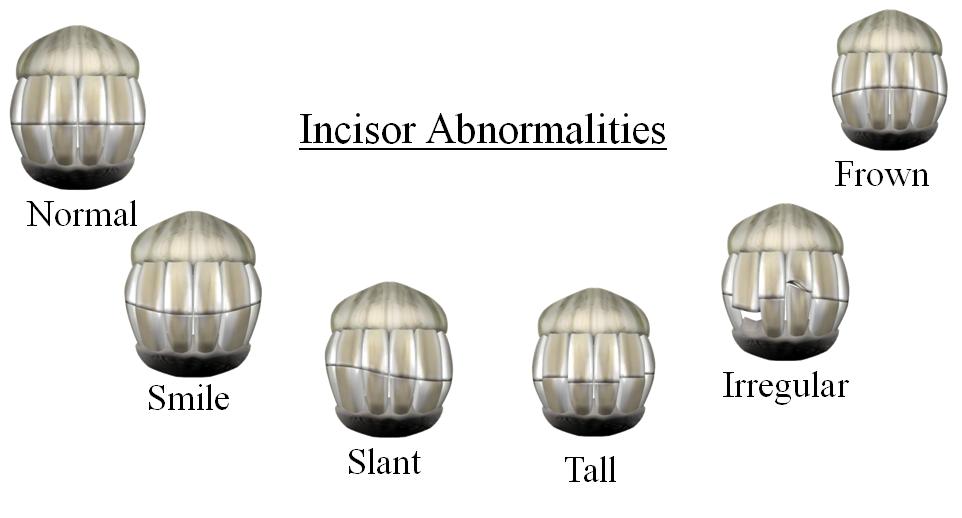
Irregular surface contact in incisors presents another concern….think chipped teeth, broken teeth, missing teeth. Horses bite down with up to 500lbs per square inch of pressure. Consider that pressure occurring repeatedly, over and over, on one or two elongated portions of an incisor or on one specific tooth. The resulting pressure is enough to crack the tooth, causing permanent damage, as the pulp chamber is exposed to air and bacteria. The entire tooth can be lost to decay simply because it was not properly aligned.
Appropriate equine dental care balances the horse’s mouth….and that balance involves all points of contact….not just the molars. Ideally, the goal is to preserve the normal chewing (grinding) function which in turn promotes digestion of food sources and your horse’s overall wellness. But for horses being ridden, that balance can also have a direct impact on how well your horse can respond to cues….horses’ teeth need even contact to allow for the sliding jaw movements associated with flexion and turning. If the teeth and mandible can’t move freely, chances are your horse can’t either!

So the answer to the question is yes, your horse’s crooked incisors do matter! Examining them for alignment and correcting them for abnormalities should occur at each and every dental visit. Be sure to ask us to give you a good look at your horse’s mouth when we see them next…..we’d be happy to show you!
References: Equimed.com, Equidentist.uk, Learninghorses.com
 Advanced Equine Dentistry Inc.