
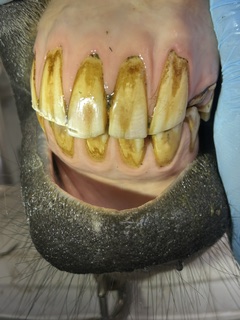
During your horse’s dental visit, you are likely to hear Rich discuss “3 point balance” and its importance to your horse. The concept is pretty simple…horse’s teeth touch across all arcades but it is easiest to picture that in 3 places (incisors, right and left molar arcades) the horse’s teeth align for their function. It makes sense that your horse’s teeth have to touch appropriately to chew food….but they also have to touch appropriately to wear their dental surfaces correctly. In order for a dental surface to wear evenly, it must have a corresponding surface to wear against. Horses teeth are not flat and they are not the same top and bottom (another lesson to come!) but they do need to touch to wear. When one tooth surface is irregular, missing, or displaced, the tooth that opposes it does not grind against it in a normal fashion. The places that don’t “grind” erupt without restriction and cause the elevations we know as hooks, ramps, step up/down, points etc….
So what causes a horse tooth to have no opposing surfaces? Lots of things…
- elongated or irregular incisors prevent proper contact of other incisors and of all molars (incisors should be even and have contact)
- displaced incisors, molars or premolars prevent wear of specific parts/portions of the opposite tooth
- missing teeth prevent wear as there is no tooth to grind against where to socket is
- abnormal chewing patterns from jaw injury or muscle tone keep teeth out of contact
- existing “hooks”, “ramps”, “points” in the mouth prevent the arcades from touching normally and create gaps in contact on the opposite teeth. This allows for further unworn eruption.
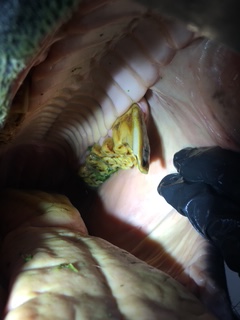
So….to give an example. Let’s say your horse has this enormous hook on his premolar. That hook causes a cascade of problems. First the horse can not grind that hook down against the opposing tooth, so it will keep getting bigger. Second, because the horse can’t close down on that hook, the only way for it to get its molars in contact to chew is by shifting the jaw….it has to move that hook out of the way for the teeth to touch. So that creates problem three; as the jaw shifts, the back teeth no longer align either allowing for uncontrolled eruption on the last molars too!! And chewing is only part of the problem! How about riding? A hook like this prevents the horse from having both lateral and anterior/posterior movement of its jaw which are needed for normal movement of their head and neck.
So….once abnormal, your horse can not correct the balance of its tooth surfaces on its own. It will continue to erupt and get larger with each year’s growth. Maintaining this balance is just one of the many reasons for routine preventative dental care (there are many more!) as part of the dental is correcting this alignment, eruption, and contact. Join us in the trailer and we will be happy to show you all the intricacies of your horse’s mouth!
References: Utah State University Extension, Equine Dental Care, 2020, Jeffrey, D. (1996). Horse dentistry, the theory and practice of equine dental maintenance.

