Upcoming Equine Dental Care? Some pointers on safety!

It’s starting to feel like spring is close and many clients are scheduling dental care for their horses. With more than 500,000 horses estimated to live in Florida, many practitioners are providing equine dental care and their methods/services vary greatly. Obviously the standards of equine dental care have evolved over time as have the procedures and the tools….plus each horse owner has their own personal preferences that influence their choice of provider. But there are a few specific points which truly matter in maintaining safe and adequate services for your horse…..we recommend these as your “minimum” standard for anyone you are hiring for equine dentistry.

  1. Both a speculum and adequate lighting is utilized (A full size horse’s oral cavity is long, dark, and holds up to 44 teeth. It is impossible fully access the furthest molars without opening their mouth and you can not see to the last teeth without lighting)
  2. All insertion of instruments is fully visualized (No sharp or hard objects should go into your horse’s mouth without the practitioner being able to see the tool. No sharp object should go into your horse’s mouth from an angle that it can not been seen)
  3. Your horse’s incisors are examined and aligned (Incisors erupt in the same manner as their rear teeth. Abnormalities of the incisors can alter how the horse’s molars make contact and can impact alignment and chewing)
  4. The practitioner you hire is insured!!!!! (Please, please….”equine liability” is relative to horse behavior, not professional practice. Any person on your property should have liability coverage relative to the services they perform, their own safety, and your property.)

We look forward to seeing our “regulars” and meeting new clients this season and hope you all get to spend some quality time with your horses! Be safe and happy riding!

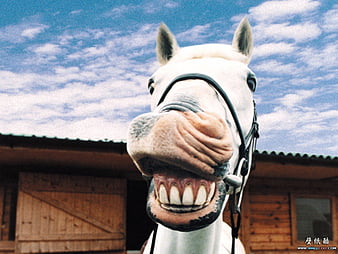
Photo courtesy of APC Languages 2016.

My Horse’s Front Teeth aren’t Straight….Does it Matter?

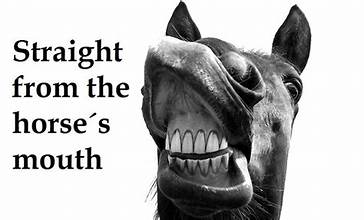
The short answer to that question…..absolutely YES! In fact, horses should have their front teeth (incisors) examined and aligned at each and every dental visit.

If we consider equine dental anatomy, the reason is pretty clear. Horse’s front teeth touch; they should line up evenly and make contact across all incisors. This point of contact influences how a horse’s teeth make contact with their molars (chewing teeth) and abnormalities in the incisors can alter their ability to move their jaw and chew. The opposite is true too…abnormal tooth surfaces on the molars alter the contact of the incisors….but for some reason, horse owners seem less aware (and less demanding) of the appropriate care needed for those front teeth!

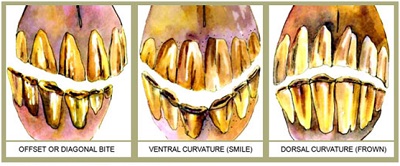
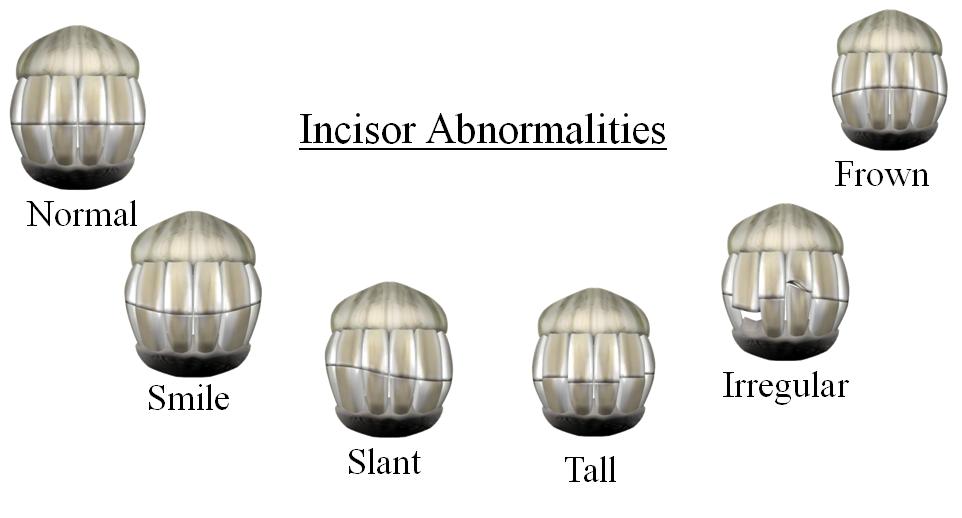
Some of the most common abnormalities we see are offsets and specific curvatures of the incisors, like a smile. If you were to imagine all of the equine teeth and their position, it becomes evident how these variations in surfaces would change where, and if, the molars touch at all. For example, a horse with an offset would have it’s molars “lifted” on the elongated side. The figure eight chewing pattern would be forced into an abnormal shape and, where the molars don’t make contact, the horse would be susceptible for hyper-eruption of the tooth surface….altering their chewing and movement even more.

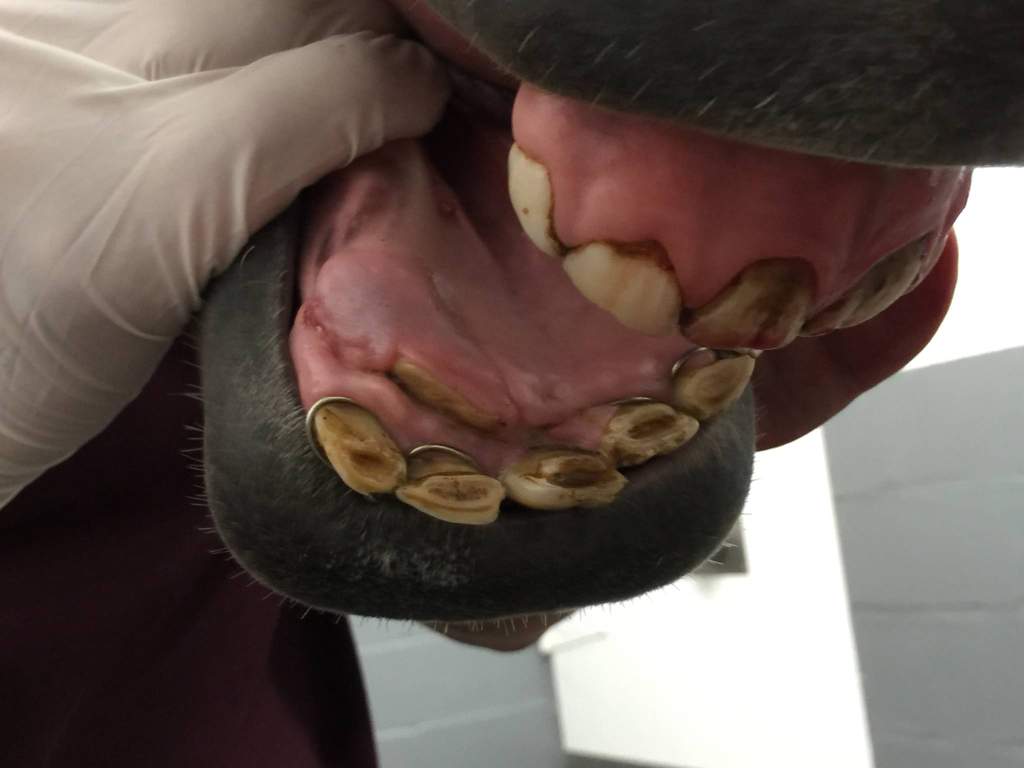
Irregular surface contact in incisors presents another concern….think chipped teeth, broken teeth, missing teeth. Horses bite down with up to 500lbs per square inch of pressure. Consider that pressure occurring repeatedly, over and over, on one or two elongated portions of an incisor or on one specific tooth. The resulting pressure is enough to crack the tooth, causing permanent damage, as the pulp chamber is exposed to air and bacteria. The entire tooth can be lost to decay simply because it was not properly aligned.

Appropriate equine dental care balances the horse’s mouth….and that balance involves all points of contact….not just the molars. Ideally, the goal is to preserve the normal chewing (grinding) function which in turn promotes digestion of food sources and your horse’s overall wellness. But for horses being ridden, that balance can also have a direct impact on how well your horse can respond to cues….horses’ teeth need even contact to allow for the sliding jaw movements associated with flexion and turning. If the teeth and mandible can’t move freely, chances are your horse can’t either!

So the answer to the question is yes, your horse’s crooked incisors do matter! Examining them for alignment and correcting them for abnormalities should occur at each and every dental visit. Be sure to ask us to give you a good look at your horse’s mouth when we see them next…..we’d be happy to show you!

References: Equimed.com, Equidentist.uk, Learninghorses.com

Let’s Say It Again….Danger for Horse Teeth!

It’s that time of year again and Advanced Equine Dentistry wants to reach out and remind all of our clients about the danger of compressed and bundled hay sources for equine teeth. If you’ve met us, you will have heard Rich review the physical reasons why horse’s teeth and jaw are not designed for “gnawing”……which is the specific action necessary for them to pull/pry hay from a compress block or tightly wrapped roll. Repeated gnawing damages their gums leading to cases of gingivitis and wears away the enamel on their teeth exposing the inner layers of the tooth to bacteria. BUT, we are Florida horse owners too and we know that large pasture blocks, round bales, and tightly packed hay nets are some of the ways owners combat the high cost of providing good nutrition and continuous grazing for their horses….especially during the winter months.

So, while we wish these feeding methods weren’t needed, what we really, really want horse owners to remember is how crucial it is that they remove all wires, strings, bindings, and wrapping from these hay sources. Each year we see near weekly oral injuries from hay sources resulting in foreign bodies lodged in the mouth, loose teeth, lost teeth, and broken mandibles. During the process of eating, the wires and strings easily get caught between horse’s teeth, wrap around horse’s teeth, slide under caps in young horses, and get twisted around the lower jaw. For the size of this animal, the jaw structure is not particularly strong and is quite narrow between the incisors and molars. With compressed hay weighing anywhere from 750-1500lbs, when the wires/strings are caught and the horse pulls back to try to free themself, the bones and teeth give way long before the binding breaks or the bale moves. The injuries take just moments; the damage can last forever! So, in order to avoid harm to your horses, please, please, please….remove all wires, strings, nets, and bindings from hay sources!!!!

Good Fun/Great Cause for Halloween!

Advanced Equine Dentistry is proud to be a sponsor of the Pasco Horseman’s Association. Their annual benefit event, “Back the Boo” raises funds for the K9 division of the Pasco County Sheriff’s department and takes place around Halloween each year. This year promises to be spectacular with two awesome events; a dinner with the K9 superstars on Friday October 27 and a Costume contest, trick or treat, kids games, goodies, and K9 demonstrations on October 28. So if you are looking for some Halloween fun and a way to support some amazing groups……head over to Hudson with us for these special events!

How Old is my Horse REALLY…..Please!

During any given work week at Advanced Equine Dentistry, we get the somewhat stressful task of telling a client that the new horse they were “assured” is “10 years old” is actually much, much closer to 20. Sometimes it is as simple as the previous owner never knew the horse’s real age and of course, sometimes they have been misled. Sadly, aside from a cursory glance, most pre-purchase examinations don’t focus on dentition unless abnormalities are obvious and they also frequently don’t see enough of the teeth to gather information about aging. If the horse changes hands without a veterinary exam, the new owner often bases the horse’s age on the EIA coggins they are given…..which in no instance is proof of age for any horse. Unless the horse is registered, with a recorded date of birth, the teeth are the most accessible method to determine their age.

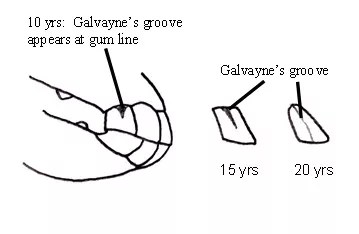
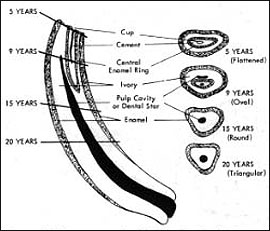
The reason that aging horses by their dentition is accurate to about +/- six months is based on the specific growth and eruption patterns of equine teeth. Horses teeth change shape uniformly as they erupt over the years and the markings visible to your equine dentist are specific to specific developmental stages. To actually accurately age a horse, it is imperative that the horse’s teeth be examined for their shape and growth angle, the position of the “cups” and dental star, the presence and length of the Galvayne’s groove, development of 7 and 11 year hooks, and the wear of the first premolars. Those assessments evaluated all together allow for the closest estimate of age. Aging a horse is definitely more involved than flipping up their top lip and looking at the incisors. While most clients know that the “Galvayne’s grove” is significant in determining age, what they don’t often know is that it simply isn’t enough information for accuracy AND that it can be altered by a “less than honest” horse dealer with a file or dremmel.

A great horse is still a great horse….even if they turn out to be 10 years older than you planned, but it certainly can change both your expectations of the horse and your future care of them if you find out after you get home. To help avoid the surprise, take the time to learn about your horse’s teeth….and of course, call your equine dentist or veterinarian for help!

My Horse has a Cavity???

Yes! Your horse can get cavities just like you can…..kind of! Horse’s teeth have much the same composition as yours do and those tooth structures can decay when organisms enter the tooth through damage to the enamel surfaces. The advantage horse’s have is that their teeth are erupting continuously throughout their life….so if the caries develop slower than the rate of tooth decay, sometimes the cavities are literally worn off before they cause permanent damage to the tooth integrity. When Rich does his comprehensive dental exam on your horse, he often notes that they have “caries” and then will let you know if those caries need treated now or can be watched. Just like in humans, untreated dental caries can lead to weakening of the tooth structure, fractures of the teeth, and dental infections. Because horses chew many, many more hours of the day than we do and because their natural chewing pattern is to grind their teeth across each other (not chomp up and down like us!), having a “hole” in the center of their tooth weakens the structure a lot! Advanced Equine Dentistry regularly completes composite dental fillings to preserve those teeth and to try to prevent tooth loss. As our horses are living longer and longer life spans, saving a tooth and keeping their teeth functional longer is a great help in keeping them healthy.

Please, please Cut the Wires off of your Hay Blocks!

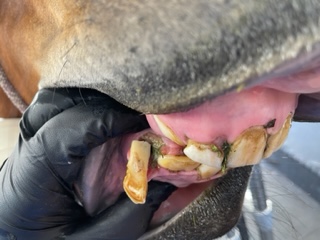
We frequently remind our clients that hay blocks in general are very hard on a horse’s teeth….no matter how much some might find them convenient. Horses’ dentition is not designed to “gnaw” and the act of trying to get hay off those tightly packed blocks (and tightly packed hay nets) damages their gums and their enamel…..sometimes beyond repair. But, a much more dangerous aspect of the hay blocks are the wires or strings they are bound with…..they are easily caught between and around horses teeth causing serious injuries. During this time of year, with the increase in hay use, we see horses on a weekly basis with hay block injuries. This photo is a young horse treated this recently…..the wire on his hay block caught on his cap (baby tooth) and in the process, completely fractured off his underlying permanent tooth at the gum line. His permanent tooth was completely destroyed.

But young horses aren’t the only concern and a horse doesn’t need to have caps in place to get caught; the wire and string bindings can get trapped between teeth and wrap around them, even in adults. Damage to their teeth certainly happens, but is not the only concern. Horses frequently break their jaw when caught on the wires. The bone structure at the front of their mouth is pretty thin and when a “trapped” horse fights to get free of the wire stuck there, they can fracture it straight through!

So….our goal is not to debate the use of hay blocks. We truly get the economic aspects of horse care since we own horses ourselves. Just please, please, please….cut the wires and strings off of your hay to protect your horses!

Foxtail Alert…We are Seeing Increased Numbers of Horses with Foxtail Ingestions

Advanced Equine Dentistry has examined and treated an increased number of horses with foxtail injuries to their teeth, gums, tongue in the last couple of weeks. The horses have been from Hillsborough county and south so far, and no specific hay supplier has been identified. The most common symptom reported has been profuse drooling but they have also exhibited swelling of the tissues, oral ulcerations, unusual tongue movements, an unwillingness to be touched, and barbs visible in the mouth and lips. Some owners noted head tossing and a general discomfort when utilizing a bit.

Identifying foxtails in an equine mouth can be a challenge as they aren’t fans of opening their mouth on command. If possible, you can hold their tongue to the side (they generally won’t bite down on it for a short period) or you can try using a twitch. If successful, you’ll want to be sure to check all surfaces….the barbs tend to move under the tongue and into the roof of the mouth. If they will not cooperate, you’ll need help from your equine dentist or your veterinarian and the use of a speculum. The thistles and seedpods are barbed and difficult to see without good lighting and oral access. This is the best photo we could find to give you an idea of what they look like (Image copied from Pet Helpful.com)

Removing foxtail barbs is a manual process. You can try rinsing if they aren’t firmly embedded, however actually grasping each barb with tweezers is most effective. Depending on the number ingested, this may take several attempts as they move to the surface of the tissue. The single best way to treat foxtail injuries is to prevent them from occurring…..examine your own pastures for the foxtail plants and examine the hay you are purchasing for visible plants, thistles, and seed pods prior to feeding. These few moments of preparation will save your horse from a painful oral injury!

References: Pennsylvania State University College of Agricultural Sciences, Washington State University Agricultural Extension, Pet Helpful.com.

Why AED Recommends Equine Dental Exams Twice a Year

Horse’s teeth do not grow, they erupt at a constant rate throughout the lifespan of their teeth. The teeth which are 4 1/2 to 5 inches long as a young adult, exist below the gum line with only the crown portion exposed. Over the first year, horses develop their 24 “baby teeth” and under which some of the permanent teeth will come into place. From the age of 1-5, all of the horse’s permanent teeth will erupt and those that are replacing the original baby teeth will push those baby teeth out as caps. Throughout their lifetime many changes occur in the dentition of your horse and the tooth surfaces are “supposed” to be worn away evenly with proper chewing as they erupt. By the time a horse is aged, the teeth “expire” leaving only root stubs or simply no tooth at all.

So what changes that process? A whole collection of things:

  1. Caps may come off unevenly or not completely (a cap or portion of a cap that remains can alter the tooth eruption of surrounding and opposing teeth)
  2. Bone grow of the jaw is uneven (overjets, underjets, overbite, underbite)
  3. Genetic defects allow for less than optimal dental development (horses in nature with bad tooth structure did not survive and were not bred)
  4. Modern feed and feeding methods impair the appropriate “grinding” of tooth surfaces (horses teeth are designed to chew grasses for >20 hours/day with their head down)
  5. Lateral movement of the jaw is impeded by dental abnormalities and further impairs “grinding ” of tooth surfaces (once you have “hooks” and “ramps” or elongated incisors, you no longer have normal chewing)
  6. Broken teeth cause discomfort through sharp edges and exposed nerves and disrupt the chewing pattern as the horse tries to avoid that tooth while eating.
  7. Individual teeth “expire” with aging and opposing teeth may hyper-erupt without an surface to grind against.

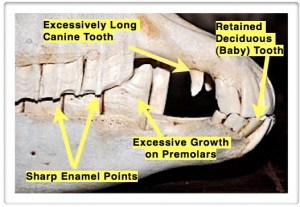
A comprehensive equine dental exam is not the same thing as a routine “float”. While very often, sharp “points” are removed during our visit, the purpose of the exam itself is to identify misshapen teeth, structural abnormalities, retained caps or portions of caps, misaligned teeth, oral injuries, or dental infections that can not be seen without actually opening your horse’s mouth…..or somehow getting them to tell you! The points/sharp edges that are addressed during dental care are simply components of the teeth that have not ground (or worn) evenly as the teeth erupted and now press into tender mouth tissues causing lacerations and discomfort. While those “points” seem to get all the attention, they are only a small portion of what is happening during the exam.

The recommendation to have your horse’s teeth examined twice a year is based on the fact that their mouth is continually changing, that they are prey animals and will naturally hide any injury/illness, that we can not see inside their entire mouth without lighting and tools, and because they simply can’t tell us what is wrong! Advance Equine Dentistry is honored to be your partner in protecting the wellness of your horses by providing comprehensive dental care!